
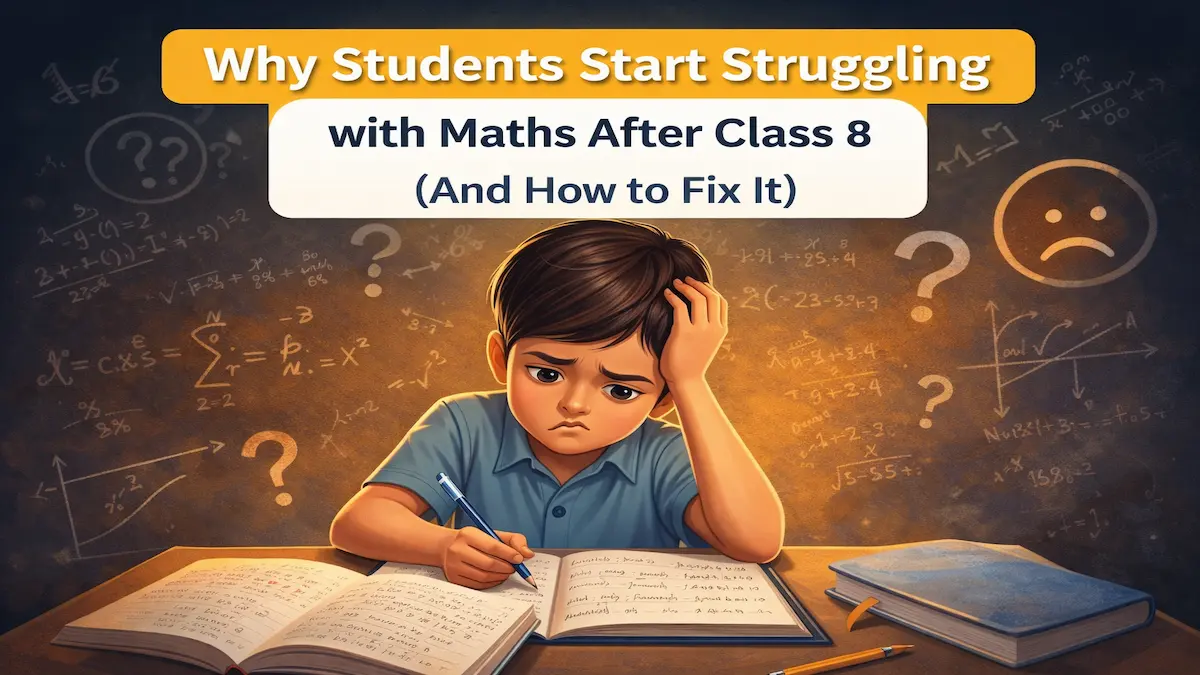
Why Students Start Struggling with Maths After Class 8 (And How to Fix It)
Many students who were comfortable with maths in earlier classes suddenly begin to struggle after Class 8. Parents often notice a drop in confidence, slower problem-solving, and growing anxiety around tests. This change is not because students become “weak at maths,” but because the nature of mathematics fundamentally changes at this stage.
Understanding why this happens is the first step toward helping students regain clarity and confidence.
What Changes in Maths After Class 8?
Up to Class 8, maths is largely procedural. Students can score well by memorising steps and practising similar questions. After this point, maths becomes:
More concept-driven rather than rule-based
Strongly dependent on logical reasoning
Focused on multi-step problem-solving
Less forgiving of weak fundamentals
Topics such as algebra, geometry, trigonometry, and linear equations are no longer isolated chapters — they begin to connect with each other.
Common Reasons Students Start Struggling After Class 8
1. Weak Conceptual Foundation
Small gaps from earlier classes—fractions, basic algebra, number sense—start compounding. What once felt manageable becomes overwhelming when concepts build on each other.
2. Shift from Calculation to Application
After Class 8, exams increasingly test application-based and higher-order thinking questions, not direct formula usage. Students who rely only on memorisation often feel stuck.
3. Faster Academic Pace
Schools move quickly to complete the syllabus, leaving little room for revision or doubt-clearing. Students who hesitate to ask questions fall behind silently.
4. Exam Pressure Starts Early
Board-oriented preparation begins in Class 9. The pressure to “perform” increases, often leading to fear, stress, and avoidance of maths practice.
How Maths Struggles Affect Students Emotionally
Maths difficulty is not just academic — it affects a child’s confidence.
Common signs include:
Avoiding maths homework
Saying “I’m bad at maths”
Panic during tests
Losing interest in STEM subjects
Without timely support, this mindset can persist into higher classes.
How These Struggles Can Be Fixed (With the Right Approach)
The good news: maths struggles after Class 8 are completely fixable with the right strategy.
1. Focus on Concept Clarity First
Before solving exam-level questions, students must clearly understand why a method works. Concept-first learning builds long-term confidence.
2. Structured, Step-by-Step Practice
Random practice rarely helps. Students improve faster with:
Topic-wise progression
Increasing difficulty levels
Regular revision cycles
3. Personalised Learning Pace
Every student learns differently. Personalised academic support, including structured online maths tuition, can help identify weak areas early and correct them before they grow.
In many cases, structured support such as CBSE-focused maths guidance helps students regain consistency and confidence.
4. Consistent Doubt Resolution
Unresolved doubts create long-term fear. Regular interaction and feedback ensure students don’t carry confusion forward.
Why Early Intervention Matters
Classes 9 and 10 form the foundation for board exams and higher studies. Addressing difficulties early:
Improves board exam readiness
Reduces exam anxiety
Builds independent problem-solving skills
Educational research consistently highlights the importance of conceptual learning in mathematics, showing that students who understand underlying concepts perform better in higher classes and competitive exams.
Frequently Asked Questions (FAQs)
Why do students suddenly find maths difficult after Class 8?
After Class 8, maths shifts from basic calculations to concept-based and application-oriented problem solving. Students who rely on memorisation often struggle when topics require logical reasoning and multi-step thinking.
Is it normal for good students to struggle with maths in higher classes?
Yes. Even academically strong students may struggle if their foundational concepts are unclear. This is common and does not mean the student lacks ability—it usually indicates a gap in understanding earlier topics.
Which maths topics cause the most difficulty after Class 8?
Students commonly find algebra, geometry, linear equations, and trigonometry challenging because these topics are interconnected and require strong conceptual clarity rather than rote practice.
Can maths performance improve after Class 8?
Absolutely. With concept-focused learning, structured practice, and regular doubt resolution, most students show significant improvement and regain confidence in maths.
How early should parents address maths difficulties?
The earlier the better. Addressing difficulties in Class 8 or early Class 9 prevents long-term learning gaps and reduces stress during board exam preparation years.
When Should Parents Consider Extra Support?
If your child is struggling with maths after Class 8, early guidance can prevent long-term gaps. Personalised academic support focused on concepts—not shortcuts—often makes the biggest difference.
Final Thoughts
Struggling with maths after Class 8 is common — and solvable. With concept-first learning, structured practice, and personalised academic support, students can rebuild confidence and perform strongly in higher classes.
The key is not more pressure — but better learning strategies.